


1/29/26
In the matter of PETITION FOR MODIFICATION
Allegheny Metallurgical, LLC
LONGVIEW MINE
Mine I.D. No. 46-09447 Docket No. M-2025-056-C
PROPOSED DECISION AND ORDER
On August 28, 2025, Allegheny Metallurgical, LLC filed a petition seeking modification of the application of 30 Code of Federal Regulations (30 C.F.R.) § 75.1002(a) at its LONGVIEW MINE located in Barbour County, West Virgina. The petitioner alleges that the alternative method in the petition will at all times guarantee no less than the same measure of protection afforded to the miners by the standard.
The petitioned standard, 30 C.F.R. § 75.1002(a) – Installation of electric equipment and conductors; permissibility states,
Electric equipment must be permissible and maintained in a permissible condition when such equipment is located within 150 of pillar workings or longwall faces.
The petitioner is requesting a modification of the standard to allow the use of unapproved Powered Air Purifying Respirators (PAPRs) within 150 feet of pillar workings or longwall faces. Specifically, the petitioner is requesting to utilize the 3M Versaflo TR-800 Intrinsically Safe (Versaflo TR-800) PAPR motor/blower and battery with battery pack. The CleanSpace EX PAPR was granted in previous Proposed Decision and Orders, Docket Number M-2022-034-C. Once this PDO becomes final, these Terms and Conditions will supersede the previous Terms and Conditions found in M-2022-034-C, and will apply to the use of both 3M Versaflo TR-800 and CleanSpace EX PAPRs.
The petitioner states that:
1. It currently uses the MSHA-approved 3M Airstream Headgear-Mounted (Airstream) PAPR System to protect miners working on its working section. The Airstream provides a constant flow of filtered air to protect against potential exposure to respirable coal mine dust during normal mining conditions. The Airstream is being discontinued by the manufacturer, no replacement components will be available, and there are no other MSHA-approved units.
2. The Versaflo TR-800 PAPR with motor/blower and battery qualifies as intrinsically safe, based on reports by the International Electrotechnical Commission Systems for Certification to Standards Relating to Equipment for Use in Explosive Atmospheres (IECEx). The blower is certified by Underwriter Laboratories (UL) with an intrinsically safe rating of Division 1: Class I, II, III; Division 1: Groups C, D, E, F, G; T4 under the current standard of UL 60079; ATEX-certified with a rating of “ia.” The Versaflo TR-800 is rated and marked “Ex ia I MA, Ex ia IIB T4 Ga, Ex ia IIIC 135oC Da; -20oC ≤ TA ≤ +55oC.”
3. The Versaflo TR-800 PAPRs provide a constant flow of air inside the headtop or helmet. This airflow provides respiratory protection and comfort in hot working conditions.
4. The Versaflo TR-800 is not MSHA-approved as permissible, and 3M is not pursuing MSHA approval.
5. The alternative method in the petition will at all times guarantee no less than the same measure of protection afforded to the miners by the mandatory standard.
The petitioner’s alternative method addresses training, inspections, examinations and records, servicing, continuous monitoring for methane and procedures when 1.0 percent or more methane is detected, battery chargers, battery charging and change out procedures, and special precautions for lithium batteries. These proposed terms and conditions for the use of Versaflo PAPRs are consistent with those approved by MSHA for previous petitions, with one major exception.
The petitioner did not include the following condition regarding treatment of lithium batteries approaching the end of their life cycle: “The battery must not be used at the end of its life cycle (i.e., when there is a performance decrease of greater than 20% in battery-operated equipment). The battery must be disposed of properly.” The electrolyte used in Lithium-ion batteries is volatile and can ignite under certain circumstances, including overcharging. MSHA requires inclusion of this additional condition to reduce the possibility of thermal runaway, and a subsequent fire or explosion caused by a battery self-igniting.
MSHA personnel investigated the merits of the petition and filed a report of their findings with the Administrator for Mine Safety and Health Enforcement. After a careful review of the entire record, including the petition and MSHA's investigative report, the Administrator issues this Proposed Decision and Order.
Findings of Fact and Conclusions of Law
MSHA investigated pertinent details of the LONGVIEW MINE from November 24, 2025 through December 15, 2025. The investigation included an item-by-item review of the proposed petition and an onsite mine visit. During the onsite visit, the MSHA investigators verified that the proposed Petition for Modification (PFM) was posted on the mine’s bulletin board and explained the PFM process and all stipulations to the miners and supervisors.
The following individuals participated in the investigation at the LONGVIEW MINE as representatives of Allegheny Metallurgical, LLC:
1. Bob Plum
2. Jamie Paynter
3. Charlie Ferguson
4. Zach Cullum
5. Dave Maynard
6. Brad Phillips
There was no Representative of Miners at the mine; however, a copy of the PFM was posted on the mine bulletin board. No negative comments were provided.
The LONGVIEW MINE is located at 620 Peel Tree Road, Volga, West Virginia. The mine extracts coal from the Lower Kittanning seam, operating one longwall section and three continuous miner sections. There is one shaft and one slope for the underground mine. The mine employs approximately 416 coal miners and operates two shifts per day. The average mining height will be 6.5 feet. The LONGVIEW MINE reported 887,273 tons of coal production for 2024. The mine liberates approximately 2,885,210 cubic feet of methane in a 24-hour period.
The Versaflo TR-800 features a helmet with a visor that flips up, connected by a hose to the fan motor/ battery pack which mounts on a belt.
The granting of this petition would affect all underground miners at the mine.
The petitioner alleges that the alternative method proposed in the submitted petition will, at all times, guarantee no less than the same measure of protection afforded by the standard.
During the comment period of the Petition for Modification, MSHA received multiple comments from the public. The public comments are available at MSHA’s website at www.msha.gov and www.regulations.gov. MSHA carefully considered all comments prior to the issuance of this Proposed Decision and Order.
Intrinsic Safety
Information regarding the UL listing for the Versaflo TR-800 PAPR was previously submitted to the MSHA Approval and Certification Center (A&CC). A review was requested for the use of these unapproved PAPRs in areas of mines where permissibility is required. A&CC conducted the reviews and concluded that:
1. The Versaflo TR-800 PAPR is certified by UL according to the ANSI/UL 60079-11 standard. The UL certificate allows 3M to mark the device as “Ex ia I”, meaning that the unit is certified to be used in hazardous locations (“Ex”), has met the most onerous level of intrinsic safety protection (“ia”), and the Equipment Protection Level (“very high”) is acceptable for use in mines susceptible to firedamp (“I”). Due to legal and regulatory constraints, the UL certificate alone is not sufficient approval.
NIOSH researchers, in a paper titled “An Evaluation of the Relative Safety of U.S. Mining Explosion-Protected Equipment Approval Requirements versus those of International Standards”, have determined that equipment which meets two-fault intrinsic safety as defined in the ANSI/UL 60079 standard would provide at least an equivalent level of safety as that provided by equipment approved to MSHA criteria.
The UL certifications, TSA certifications, and 3M listing materials (drawings, certificate and text report) were found to support the conclusion that the Versaflo TR-800 meets the ANSI/UL standard’s “two fault” intrinsic safety requirements for mining equipment.
The Versaflo TR-800 carries an ingress protection rating of IP64, which exceeds the minimum rating of IP54 required by the ANSI/UL and IEC standards for intrinsically safe mining equipment.
Electromagnetic Interference Investigation
Review of the submitted materials indicate that both units, as unintentional radiators, have been tested and found to meet Federal Communications Commission (FCC) Title 47, Code of Federal Regulations, Part 15 requirements for digital devices for use in typical industrial environments. This means that, under the test conditions and in industrial environments, they were found to not cause harmful interference. Nevertheless, MSHA investigators tested the equipment in the mine to determine if PAPR electrical components such as the pump motor or battery create interference when used in close proximity to other electrical equipment.
On December 15, 2025, MSHA investigators traveled underground to the mine’s working sections to test for potential interference between the non-permissible PAPR at issue and electrical equipment typically worn, carried, or operated by miners on the working sections, as well as other electrical equipment. See Tables 1 and 2.
Mine personnel provided electrical equipment typically used in conjunction with the PAPR for testing. The PAPR tested in this investigation was a Versaflo TR-800 PAPR.
The investigators first performed baseline function tests for all electrical equipment, including the PAPR, by operating them individually away from one another. Then testing was conducted by placing the running PAPR in various orientations and distances ranging from 12 inches to zero inches from electrical equipment typically worn, carried, or operated by miners.
| Equipment Type | Manufacturer | Model | Interference |
|---|---|---|---|
| Communication | IWT | Sentinel Radio | No |
| Proximity Detection | Matrix | IntelliZone | No |
| Cordless Cap Lamp | Kohler | Wheat | No |
| Cordless Cap Lamp | Wise | Lite 2 | No |
| Cordless Cap Lamp | Xerebrus Inc | Flare XM-2 | No |
| Cordless Cap Lamp | Koehler | Wheat XL | No |
| CPDM | Thermo Fisher Scientific | PDM 3700-A1 | No |
| Gas Detector | Drager | X-am 5000 | No |
| Gas Detector | Industrial Scientific | IBRID MX 6 | No |
| Gas Detector | Industrial Scientific | Ventis MX 4 | No |
| Shield Control Unit | TIEFENBACH | ASG 5.2020 | No |
| Continuous Miner Remote | JOY | Type TX 3 | No |
| Shearer Remote | JOY | XR 1 | No |
| Equipment Type | Manufacturer | Model | Interference |
|---|---|---|---|
| Shuttle Car Camera | Matrix | XPE-4 | No |
| Shuttle Car Camera Display | Matrix | XPE-5 | No |
| Wireless Gas Monitoring System (AMS) | IWT | Sentinel | No |
| Methane Monitor | Matrix | M5 | No |
| Methane Monitor | CSE | 140B-LD IR | No |
Conclusion
Continuous mining machines at the mine were equipped with proximity detection systems (PDS) with a Miner Wearable Component (MWC). During testing, investigators found no interference between the PAPRs and PDS MWC.
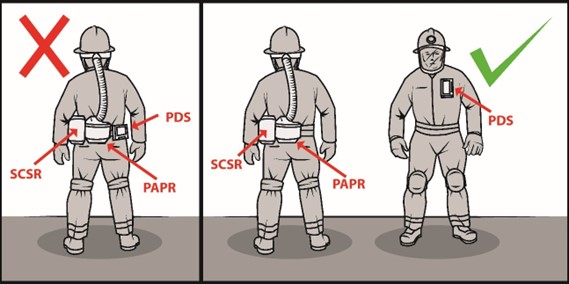
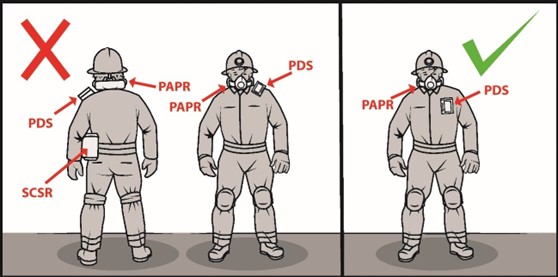
When operating or working near continuous mining machines equipped with PDS, manufacturers recommend a minimum separation distance of six inches between PDS MWCs and other electronic equipment to sufficiently reduce or eliminate interference. (See Appendix 1 for example diagrams of proper PAPR and PDS positioning on the body.)
When the PDS manufacturer’s recommendations requiring a six-inch separation between the PDS MWCs and the PAPRs’ battery pack or motor/blower were followed, MSHA testing showed no apparent interference or performance issues between the PAPRs and the electrical equipment tested typically worn, carried, or used by miners at the mine (as detailed in Tables 1 and 2 above).
Miner training should incorporate the importance of adhering to the PDS manufacturer’s recommendations so there is no interference between the PDS and PAPRs.
Based on the investigation discussed above, MSHA determined that the Versaflo TR-800 PAPR can be safely used where permissible equipment is required within 150 feet of pillar workings or longwall faces, if the operator follows all of the manufacturer’s recommendations and adheres to the Terms and Conditions of the Proposed Decision and Order.
On the basis of the petition and MSHA’s investigation findings, and the foregoing reasons, Allegheny Metallurgical, LLC is granted a modification of the application of 30 C.F.R. § 75.1002(a) at its LONGVIEW MINE.
ORDER
Wherefore, pursuant to the authority delegated by the Secretary of Labor to the Administrator for Mine Safety and Health Enforcement and pursuant to Section 101(c) of the Federal Mine Safety and Health Act of 1977, 30 U.S.C. § 811(c), it is ordered that Allegheny Metallurgical, LLC’s Petition for Modification of the application of 30 C.F.R. § 75.1002(a) in the LONGVIEW MINE is hereby:
GRANTED, conditioned upon compliance with the following requirements.
Terms and Conditions
1. Affected mine employees must be trained in the proper use and maintenance of the PAPR(s) to be used at the mine, the Versaflo TR-800 and/or the CleanSpace EX, in accordance with established manufacturer guidelines. This training shall alert the affected employees that neither the Versaflo TR-800 nor the CleanSpace EX PAPR is approved under 30 C.F.R. Part 18 and therefore must be de-energized when 1.0 or more percent methane is detected. The training shall also include the proper method to de-energize these PAPRs. In addition to the manufacturer’s guidelines, MSHA requires that mine employees be trained to examine the units before use to determine if any damage to the units exists that would negatively impact intrinsic safety, or any of the stipulations in this petition
2. The PAPRs, battery packs, all associated wiring and connections must be examined by a qualified person before use to determine if there are any observable defects or damage to the units that would negatively impact intrinsic safety. If any defect or damage is found, the PAPR must be removed from service.
3. Each PAPR shall be assigned a unique identification number. The operator shall maintain a separate logbook for the Versaflo TR-800 and CleanSpace EX PAPRs. The logbooks shall be kept with the equipment or in a location with other mine record books and be made available to MSHA upon request. The equipment shall be examined at least weekly by a qualified person as defined in 30 C.F.R. § 75.512-1 and the examination results recorded in the logbook. Since float coal dust is removed by the air filter prior to reaching the motor, the PAPR user shall conduct regular examinations of the filter and perform periodic testing for proper operation of the “high filter load alarm” on the Versaflo TR-800 PAPR, and the “blocked filter” alarm on the CleanSpace EX PAPR. PAPR examination entries may be expunged after one year.
4. In addition to the “blocked filter” alarm on the CleanSpace EX PAPR, these units have a visual green/red filter indicator that turns red when the filter needs to be replaced. The mine shall stock an adequate supply of new CleanSpace EX filters and pre-filters.
5. All Versaflo TR-800 and CleanSpace EX PAPRs to be used shall be physically examined by a qualified person as defined in 30 C.F.R. § 75.151 prior to initial use. Each unit shall be examined by the person to operate the equipment prior to taking the equipment underground to ensure the equipment is used according to the original equipment manufacturer’s recommendations and maintained in a safe operating condition.
The examinations for the Versaflo TR-800 PAPRs shall include:
a. Check the equipment for any physical damage and the integrity of the case;
b. Remove the battery and examine for corrosion;
c. Inspect the contact points to ensure a secure connection to the battery;
d. Reinsert the battery and power up and shut down to ensure proper connections;
e. Check the battery compartment cover or battery attachment to ensure that it is securely fastened; and
f. For equipment utilizing lithium type cells, ensure that lithium cells and/or packs are not damaged or swollen.
The CleanSpace EX PAPR does not have an accessible/removable battery. The internal battery and motor/blower assembly are both contained within the sealed “power unit” assembly and the battery cannot be removed, reinserted, or fastened. Therefore, examination of the CleanSpace EX PAPR should include any indications of physical damage.
The operator is to ensure that all Versaflo TR-800 and CleanSpace EX PAPR units are serviced according to the manufacturer's recommendations. Dates of service shall be recorded in the equipment's logbook and shall include a description of the work performed.
6. The Versaflo TR-800 and CleanSpace EX PAPR units that will be used shall not be put into service until MSHA has initially inspected the equipment and determined that it is compliant with all the terms and conditions of this Order.
7. Prior to energizing the Versaflo TR-800 or the CleanSpace EX PAPR, methane tests must be made in accordance with 30 C.F.R. § 75.323(a).
8. All hand-held methane detectors shall be MSHA-approved and maintained in permissible and proper operating condition. All methane detectors must provide visual and audible warnings when methane is detected in concentrations at or above 1.0 percent.
9. A qualified person shall continuously monitor for methane immediately before and during the use of the Versaflo TR-800 or CleanSpace EX PAPR.
10. Neither the Versaflo TR-800 nor the CleanSpace EX PAPR shall be used if methane is detected in concentrations at or above 1.0 percent. When 1.0 percent or more methane is detected while the Versaflo TR-800 or CleanSpace EX PAPR is being used, the equipment shall be de-energized immediately and the equipment withdrawn from the area.
11. In the Versaflo TR-800, use only 3M TR-830 Battery Pack (TR-800 Battery Pack), which meets lithium battery safety standard UL 1642 or IEC 62133. In the CleanSpace EX, use only the CleanSpace EX Power Unit, which meets the same UL or IEC lithium battery safety standards.
12. Before each shift when the Versaflo TR-800 or CleanSpace EX PAPR is to be used, all batteries and power units for the equipment must be charged sufficiently for the expected usage on that shift. If spare battery packs for the Versaflo TR-800 PAPR are provided, all battery “change outs” must occur in intake air outby the last open crosscut.
13. The following maintenance and use conditions shall apply to equipment containing lithium-type batteries:
a. Neither the TR-830 Battery Pack nor the CleanSpace EX Power Unit may be disassembled nor modified by anyone other than permitted by the manufacturer of the equipment.
b. The TR-830 Battery Pack shall be charged only on the surface of the mine, and only using a manufacturer’s recommended battery charger, such as:
i. 3M Battery Charger Kit TR-641N, which includes one 3M Charger Cradle TR-640 and one 3M Power Supply TR-941N, or,
ii. 3M 4-Station Battery Charger Kit TR-644N, which includes four 3M Charger Cradles TR-640 and one 3M, 4-Station Battery Charger Base/Power Supply TR-944N.
c. The CleanSpace EX internal battery, which is contained within the power unit assembly, shall be charged only on the surface of the mine, and only using the manufacturer’s recommended battery charger, such as the CleanSpace EX Battery Charger, Product Code PAF-0066.
d. Neither the TR-830 Battery Pack nor the CleanSpace EX power unit, which contains the internal battery, shall be exposed to water, allowed to get wet, or immersed in liquid. This does not preclude incidental exposure of the TR-830 battery pack or the CleanSpace EX power unit assembly.
e. Neither the Versaflo TR-800 PAPR nor the CleanSpace EX PAPR, including the internal battery, shall be used, charged, or stored in locations where the manufacturer’s recommended temperature limits are exceeded. Neither the Versaflo TR-800 PAPR nor the CleanSpace EX PAPR shall be placed in direct sunlight nor stored near a source of heat.
f. Neither the TR-830 battery pack nor the CleanSpace EX PAPR’s internal battery shall be used at the end of its life cycle (i.e., when there is a performance decrease of greater than 20% in battery-operated equipment). The TR-830 battery pack and the CleanSpace EX power unit containing the internal battery must be disposed of properly.
i. Follow the manufacturer’s recommendations and instructions. Check and monitor each unit’s run time. Observe and notate the initial run time that a new fully charged battery provides for powering the unit. A record of the initial run time and the date shall be made by a trained and competent person. This record shall not be expunged on an annual basis but must be retained until the PAPR and/or the battery is retired from service.
ii. Routinely check the battery’s charge status.
iii. Routinely monitor batteries that are approaching the end of their estimated service life.
iv. Remove the battery from service when the following conditions are met:
a. The battery run time drops below 80% of the new battery run time, or;
b. The battery charge time increases significantly.
v. Follow the storage instructions as recommended by the manufacturer. If the instructions were not followed for a battery stored or otherwise unused for an extended period or the battery has no charge remaining, consider it to be damaged. Do not attempt to recharge it or to use it. Remove it from service and replace it with a new battery.
14. Personnel engaged in the use of the Versaflo TR-800 and CleanSpace EX PAPRs shall be properly trained to recognize the hazards and limitations associated with the use of the equipment in areas where methane could be present. Affected mine employees shall also be trained to properly position their PDS MWC at least six inches from their PAPR’s battery/motor blower or battery/power unit to prevent interference. (See Appendix 1 for example diagrams of proper PAPR and PDS positioning on the body.) Also, personnel shall be trained regarding proper procedures for donning Self-Contained Self Rescuers (SCSRs) during a mine emergency while wearing the Versaflo TR-800 or CleanSpace EX PAPR. The mine operator shall submit proposed revisions to update the Mine Emergency Evacuation and Firefighting Program of Instruction under 30 C.F.R. § 75.1502.
15. Within 60 days after this Order becomes final, the operator shall submit proposed revisions for its approved 30 C.F.R. Part 48 training plans to the Mine Safety and Health Enforcement District Manager. These proposed revisions shall specify initial and refresher training regarding the terms and conditions stated in this Decision and Order. When training is conducted on the terms and conditions in this Order, an MSHA Certificate of Training (Form 5000-23) shall be completed. Comments shall be included on the Certificate of Training indicating that the training received was for use of the Versaflo TR-800 or CleanSpace EX PAPR.
16. All personnel who will be involved with or affected by the use of the Versaflo TR-800 or CleanSpace EX PAPRs shall receive training in accordance with 30 C.F.R. § 48.7 on the requirements of this Order within 60 days of the date this Order becomes final. Such training must be completed before any Versaflo TR-800 or CleanSpace EX PAPR can be used. The operator shall keep a record of such training and provide such record to MSHA upon request.
17. The operator shall provide annual retraining to all personnel who will be involved with or affected by the use of the Versaflo TR-800 or CleanSpace EX PAPRs in accordance with 30 C.F.R. § 48.8. The operator shall train new miners on the requirements of this Order in accordance with 30 C.F.R. § 48.5 and shall train experienced miners on the requirements of this Order in accordance with 30 C.F.R. § 48.6. The operator shall keep a record of such training and provide such record to MSHA upon request.
18. The operator shall post this Order in unobstructed locations on the bulletin boards and/or in other conspicuous places where notices to miners are ordinarily posted, for a period of not less than 60 consecutive days.
Appendix 1 – PAPR and PDS Positioning
When using a PAPR in conjunction with a Proximity Detection System (PDS), ensure that the manufacturers’ instructions are followed. To prevent interference, maintain at least six inches of separation between the PAPR and PDS’s miner wearable component (MWC). The figures below show how miners can wear these devices with belt-worn and neck-supported PAPRs, maintain the recommended separation distances between the PAPR’s battery/motor blower and the MWC, and prevent such interference.
Figure 4. Proper position of the PDS’s MWC when using a belt-worn PAPR.
Figure 5. Proper position of the PDS’s MWC when using a neck-supported PAPR.
Unless specifically mentioned herein, nothing in this Order changes or supersedes the requirements otherwise imposed by the Mine Act, other mandatory standards or regulations, or approved plans.
The petitioner shall include the above terms and conditions in the initial and annual refresher training as required in its approved Part 48 training plans to ensure that miners are aware of the stipulations contained in this petition.
Any party to this action desiring a hearing on this matter must file in accordance with 30 C.F.R. § 44.14 within 30 days. The request for hearing must be filed with the Administrator for Mine Safety and Health Enforcement, 200 Constitution Ave NW, Suite C3522, Washington, DC, 20210.
Any hearing request must contain a concise summary of position on the issues of fact or law to be raised by the party requesting the hearing, including specific objections to the proposed decision. A party other than the Petitioner who has requested a hearing may also comment on all issues of fact or law presented in the petition, and any party to this action requesting a hearing may indicate a desired hearing site.
If no request for a hearing is filed within 30 days after service of this Proposed Decision and Order, the Decision and Order will become final and must be posted by the operator on the bulletin board at the mine.
Timothy R. Watkins
Acting Administrator for
Mine Safety and Health Enforcement
Certificate of Service
I hereby certify that a copy of this proposed decision was served personally or mailed, postage paid, or provided by other electronic means this 29th day of January, 2026, to:
Daniel E. Curry
Safety Manager, Century Mining, LLC
7004 Buckhannon Road
Volga, WV 26238
dcurry@alleghenymet.com
Alexander Bullinger
General Engineer
cc:Frank Foster, Director
Office of Miners' Health Safety & Training
#7 Players Club Dr. Suite 2, Charleston WV 25311
Frank.G.Foster@wv.gov
4. Proper position of the PDS’s MWC when using a belt-worn PAPR.
5. Proper position of the PDS’s MWC when using a neck-supported PAPR.